An AI taxi booking system answers your phones, takes bookings, and logs jobs into your dispatch panel without a dispatcher on the line. If you run a taxi or private hire company in the UK, this post covers exactly how it works, where it falls short, and what operators are using it for.
There is a version of this story that every operator has lived through. It is a Friday night. Three calls come in at the same time. Your dispatcher gets to two of them. The third rings out. The caller tries once more, gets no answer, and books with a competitor.
That booking never existed in your system, so it never shows as lost. Your end-of-week numbers look fine. But that customer now has someone else’s number saved in their phone.
According to research by Invoca, businesses miss roughly 22% of inbound calls — and most of those callers do not try again. For a taxi company, every missed call is a fare that went to someone else.
5 Costly Mistakes Operators Make Without an AI Taxi Booking System
1. Relying on Voicemail
Most callers do not leave one. They move on. Voicemail was designed for messages, not for time-sensitive bookings where a caller needs a car in 20 minutes.
2. Using a Basic IVR
“Press 1 to book, press 2 for an existing booking.” Callers dislike these systems. If anything goes slightly wrong, they hang up. An IVR cannot hold a conversation, clarify a vague address, or handle a prebook for next Tuesday at 8am.
3. No Overnight Coverage
Call volume does not stop at 10pm. Airports, night shifts, hospital runs — a significant number of taxi bookings happen outside normal dispatcher hours. Without coverage, every one of those calls is lost.
4. Serving Only English Speakers
A lot of taxi operators in the UK serve communities where English is not the main language spoken at home. Romanian, Polish, Punjabi, Urdu, Bengali. An operator whose phone system only handles English is losing a portion of their customer base every week.
5. Treating Every Dispatcher Hour as Equal
During quiet periods your dispatcher is waiting for calls. During peak periods they cannot answer fast enough. Neither extreme is efficient. Automation handles the overflow so your team focuses on the work that actually needs a human.
What an AI Taxi Booking System Actually Does
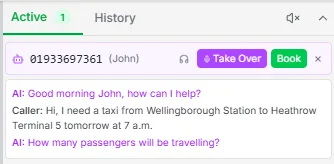
A proper AI taxi booking system holds a real phone conversation. The caller speaks naturally. They give their pickup address, their destination, and when they want to travel. The AI asks follow-up questions when it needs to. If the address is vague, it asks for the postcode. If the caller says “tomorrow morning,” it confirms the exact time before finishing the call.
Once the booking is confirmed, the job goes directly into your dispatch panel. Pickup, dropoff, passenger name, phone number, time. It appears exactly as a manually taken booking would. Your dispatcher sees it in the queue. The driver gets assigned through your normal process.
No delay. No manual entry. No risk of details being lost in a handover.
CAB-X Voice AI runs 24 hours a day. It handles overflow during peak hours, the 2am call when nobody is on shift, and the bank holiday rush without you needing to roster extra staff.
You can see the full booking flow — including a mid-call language switch and the job landing in the dispatch panel in real time — on the CAB-X Facebook page.
Multilingual Support
Here is something we noticed early in development that changed how we built the system.
Callers who are comfortable in their own language but less confident in English on the phone will hang up if the system does not follow them. A standard IVR does not help these callers. An AI that only works in English loses a real portion of certain operators’ customer bases.
CAB-X Voice AI handles multiple languages. If a caller switches language mid-conversation, the AI follows them. We have tested this with Romanian, Polish, Spanish, French, Portuguese, and others. The booking gets taken correctly regardless of which language the caller uses.
For an operator serving a large Polish or Romanian community, being the company that can take a booking in that caller’s language is a straightforward commercial advantage.
What Happens in the Dispatch Panel
The job arrives the same way any other booking does. Your dispatcher sees the pickup, dropoff, passenger name, and time. There is nothing different about it from their point of view.
If auto-assign is enabled in CAB-X, the nearest available driver gets the job automatically. If you handle assignment manually, it sits in the queue waiting to be dispatched.
The AI taxi booking system also handles status enquiries. A caller asking “where is my taxi?” gets a driver update without your dispatcher picking up the phone. It handles cancellations with a verification step so a caller cannot cancel someone else’s booking.
For prebooked jobs, the system handles future times correctly. A caller booking for Thursday at 6am gets that logged in your panel for the right date and time, not dumped into a notes field for someone to deal with later.
The Honest Limitations
We would rather be straight about this than oversell it.
Voice AI works best for standard bookings — address, destination, name, time. The vast majority of calls to a taxi company are exactly that.
It is not the right tool for complaints, complex account queries, or situations that genuinely need a human decision. CAB-X supports a transfer-to-dispatcher option for those calls. The AI recognises when it cannot help and passes the call over rather than keeping a frustrated caller in a loop.
The system is also calibrated for your local area. An operator in Northampton gets a configuration that understands Northampton streets and nearby towns, not a generic UK-wide model that guesses.
If you want to understand how voice AI compares to traditional IVR systems more broadly, Vonage published a useful breakdown of the differences between IVR and conversational AI that is worth reading.
Pricing and Next Steps
CAB-X starts from £15 per driver per month. Get in touch for Voice AI pricing.
If you want to see how a proper AI taxi booking system works for your operation, the best starting point is the live demo video on our Facebook page. It shows a full booking being taken over the phone, a mid-call language switch, and the job appearing in the dispatch panel automatically. The whole thing is about 90 seconds.
To book a demo or ask questions about your setup, visit cabx.me/contact.
For more on how CAB-X handles dispatch, driver apps, and passenger booking, see the full platform overview at cabx.me.
CAB-X is a taxi dispatch SaaS platform built for UK private hire and taxi operators. £15 per driver per month.
